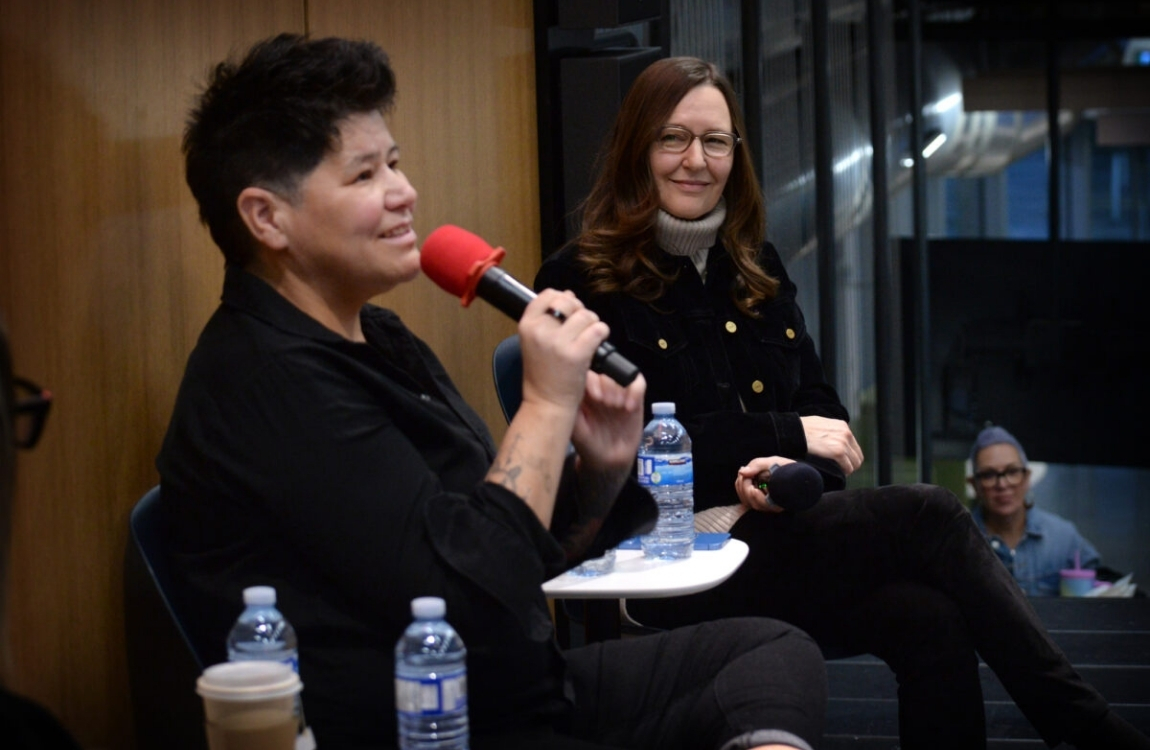
In Canada’s innovation economy, success stories are often told from the moment things finally work. Bobbie Racette focuses on what comes before that point.
Speaking at Platform Calgary earlier today, the founder of Virtual Gurus discussed how urgency, access to work, and hard trade-offs shape companies long before they resemble case studies. Her reflections offered a grounded look at what it takes to build, scale, and eventually step away from a company in today’s innovation landscape.
“You can only carry your team so far before you can’t carry them anymore,” she said.
Racette wasn’t offering that advice from a distance. She was describing the moment when leadership, growth, and responsibility collide, and when founders are forced to confront what happens after momentum runs out.
The conversation with Platform Calgary’s interim CEO Jennifer Lussier and the A100’s Tamara Woolgar surfaced a set of lessons about how innovation actually unfolds in Canada. It is rarely clean, often underfunded, and deeply tied to who gets access to opportunity in the first place.

At a time when Alberta and Canada are asking how they grow inclusive, durable companies, Racette’s experience points to where the system supports founders and where it works against them.
Virtual Gurus emerged during Alberta’s 2016 recession, when Bobbie Racette found herself out of work and began building a way to create her own job. She was working shifts at a café, then going home to manage clients on spreadsheets late into the night.
“I needed to create my own destiny,” she said.
Progress came gradually. Racette described the early years as a grind sustained by long hours and family support. Bringing on her first assistant, an immigrant woman who struggled to find work elsewhere, reframed what the business could become.
“That’s kind of when the light bulb went on,” Racette said. “If I can create my own job and I can create her job, how many others can I create?”
With that question on the table, Virtual Gurus grew into a remote talent platform serving underrepresented workers, including women, newcomers, the LGBTQ+ community, and people with disabilities.
When Racette mentioned that Virtual Gurus was originally called Canadian Virtual Assistant Gurus, amusingly shortened to CVAG, the room laughed. The name was a reminder of how unpolished early-stage companies often are.

Growth followed, but not in a straight line. Racette was managing clients herself while building the day-to-day mechanics of the business, often relying on spreadsheets and manual processes to keep up with demand.
The technology came later, often after problems surfaced.
Virtual Guru’s real acceleration came during the pandemic, when administrative workers were among the first to be laid off and remote work became unavoidable.
“COVID was our big ‘holy crap, this is going to go somewhere’ moment,” Racette said. While more companies were cutting staff, Virtual Gurus began absorbing displaced administrative workers and matching them with new clients.
“We were just bringing people in and finding them work.”
As the company grew, day-to-day decisions became harder to contain, as Virtual Gurus was no longer just matching work to workers. Racette described it as a three-sided marketplace, balancing the needs of clients, contractors, and a fast-growing internal team. When one side fell out of sync, the impact quickly surfaced somewhere else.
“When you’re scaling fast, you have to have eyes and ears everywhere,” she said. “There is not a single day that is just linear.”
That pressure intensified as Racette pursued outside capital. She said she heard more than 170 rejections while raising what she described as a relatively modest round.
Racette raised the company’s first $1.2 million in 2020, with another $1.7 million coming in a year later, and an $8.4-million round closing in 2022.
Securing funding created room to hire and build faster, but Racette said it also locked the company into a pace that was difficult to slow. Decisions that once took place over weeks had to be made in days, often without the chance to revisit them once the company moved forward.
Growth accelerated, but so did the volume and weight of decisions that landed on Racette’s desk.
She described the experience as being “forced into that uncomfortable scale,” where momentum left little room to pause or recalibrate. Over time, that pressure showed up as decision fatigue and a growing distance from the company’s original purpose.
“I always told myself that once the mission started getting forgotten, it was time for me to go,” she said.
Racette’s exit from Virtual Gurus in November was opportunity-driven, but emotionally complex. She stepped into a president role before the sale, giving herself time to detach operationally while the company transitioned.
The hardest part, she said, was not her own role changing. It was watching employees live with uncertainty she couldn’t explain.
“Everybody knew something was going on,” she said. “And I just felt really bad for them.”

Racette frames leadership as the responsibility to make decisions that keep the organization intact, even when the impact is painful.
As the company changed hands, Racette said she felt the limits of what she could sustain.
“You can’t carry everybody on your back at all times,” she said. “There comes a point where you have to say, I love you, but I have to go this way.”
Stepping away did not mean disengaging from the work itself. After years of operating at constant speed, Racette began adjusting to a different life, one that created space to reflect on her strength as a builder.
When Racette mentioned that she hadn’t set an alarm in a long time before this morning, the room laughed. Everyone arrived at 7:30 a.m. on a Tuesday, and even though there were some early risers in the crowd, most people there definitely owed their alarm a thank-you for the wake up call.
Racette’s slower pace made something clear that had been harder to see while she was running the company.
“I’m a build-it-from-point-A-to-B [person], and hand it off from B to C,” she said.
Racette is already building again, this time focused on founder education and revenue-based funding for underserved entrepreneurs. The platform, called Tapwi, is designed to share hard-earned lessons she had to learn without legal or financial guidance.

“There are a lot of truths I didn’t know as a founder,” she said. “I had to learn everything the hard way.”
Her focus aligns with a growing tension in Canada’s innovation ecosystem. While early-stage capital remains constrained, the pressure is felt most sharply by founders building outside traditional profiles and funding paths.
A 2025 report from the Canadian Venture Capital and Private Equity Association found that seed-stage investment continues to favour fewer deals and more established founders, leaving first-time and underrepresented entrepreneurs with limited options as they try to grow.
That environment is unfolding alongside broader political and cultural signals that have made many equity-seeking founders question whether progress made over the past decade is secure.
Racette framed this moment not as a reason to pull back, but as a test of whether Canada is willing to hold space for different kinds of builders.
“Because of all the scary news that’s happening and the politics and everything, now is the best time to get out there and start something,” she said. “If you’ve got a business idea — do it, build it anyway… there’s no better time than now.”